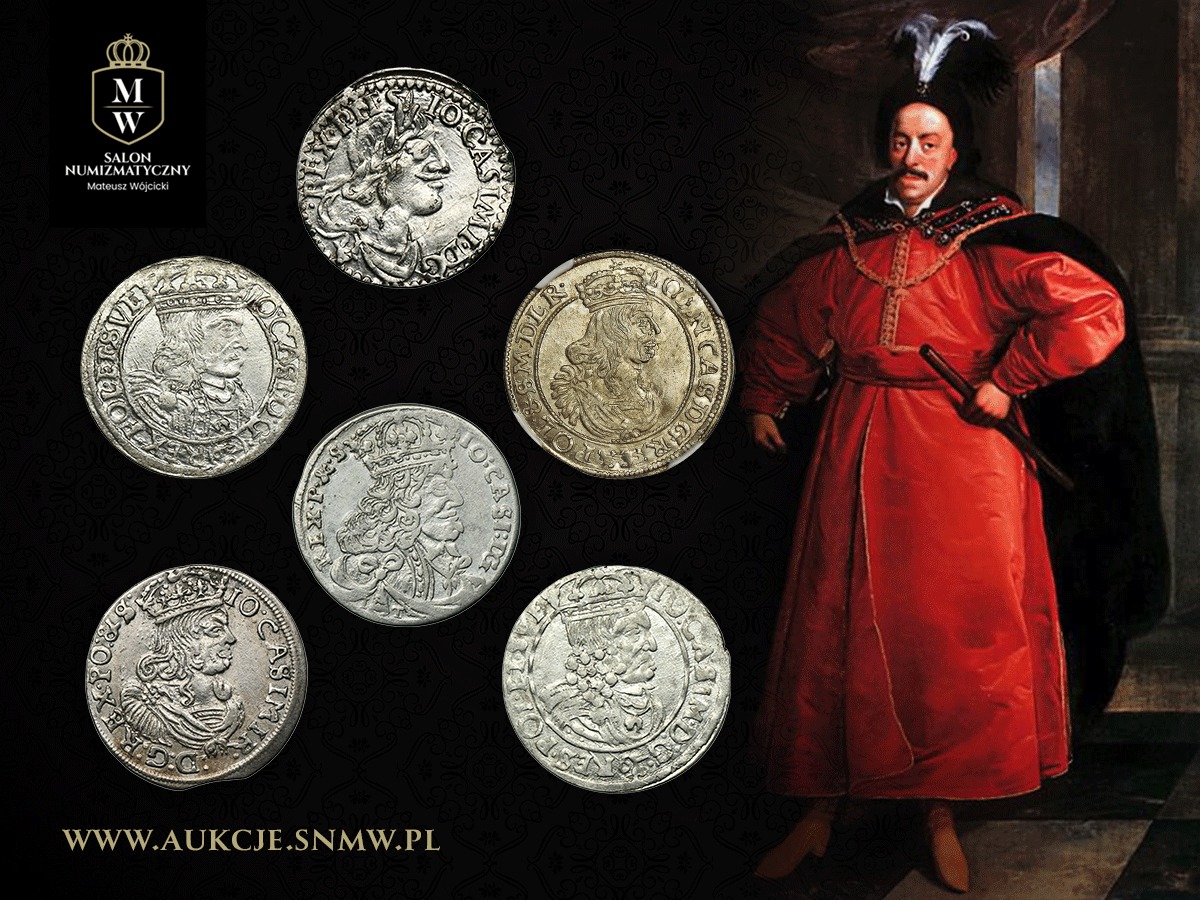
During the reign of John Casimir, the 6th coin was issued by five mints:

Wschowska (1650)
Poznań (1651, 1657, 1661, 1662)
Krakow (1656-1668)
Bydgoszcz (1650, 1660-1668)
Lviv (1656, 1657, 1660-1663)
The standard for initial mintages – Bydgoszcz 1650, Wschowa 1650, and Poznań 1651 – was determined by an ordinance of 1650. The six-coin coins were therefore minted from very good 14-grain silver, weighing an average of 1.869 g and containing 1.635 g of pure silver. However, the assumptions of the 1650 reform proved unrealistic, and were soon withdrawn by a resolution of the Sejm (1654).
During the Swedish Deluge, the Lviv mint minted six-coin coins in 1656 and 1657. The legal basis for this was the royal universal of 1656, which stipulated that six-coin coins should be minted from six-coin silver, their average weight was 3.809 g, and the pure silver content of the coin was 1.429 g (as can be seen, this is slightly lower than in earlier issues). By 1657, Kraków was in Swedish hands. The Kraków mint, under Swedish occupation, minted sixpence coins in 1656 and 1657. These coins were of a lower standard than required by the ordinance of 1656. The legal act that ultimately determined the silver fineness and weight of John Casimir's crown sixpence coins was the ordinance of 1658. According to its provisions, the sixpence coins were to be minted from silver of the sixth purity, weighed an average of 3.480 g and contained 1.305 g of pure metal.
The iconographic scheme of the 6th coin was relatively uniform. On the obverse, they featured a portrait of the king and a rim inscription with the monarch's name and title. On the reverse, beneath a crown, were the coats of arms of Poland and Lithuania, the Vasa Sheaf, and a rim inscription. Additionally, there were the treasurer's coats of arms (on the obverse or reverse), the initials of the mint administrators, and the date. The exceptions were the first issues – the Wschowa (1650), Bydgoszcz (1650), and Poznań (1651) issues. Instead of the Polish and Lithuanian coats of arms, the reverse featured only a Polish eagle with the Sheaf coat of arms on its breast (one of the Bydgoszcz varieties from 1650 has a standard design with the Polish and Lithuanian coats of arms on its reverse).