Upcoming auctions:
Nearest mobile office:

1st Special Auction in Krakow - May 23, 2026 - INDIVIDUAL RECEPTIONS
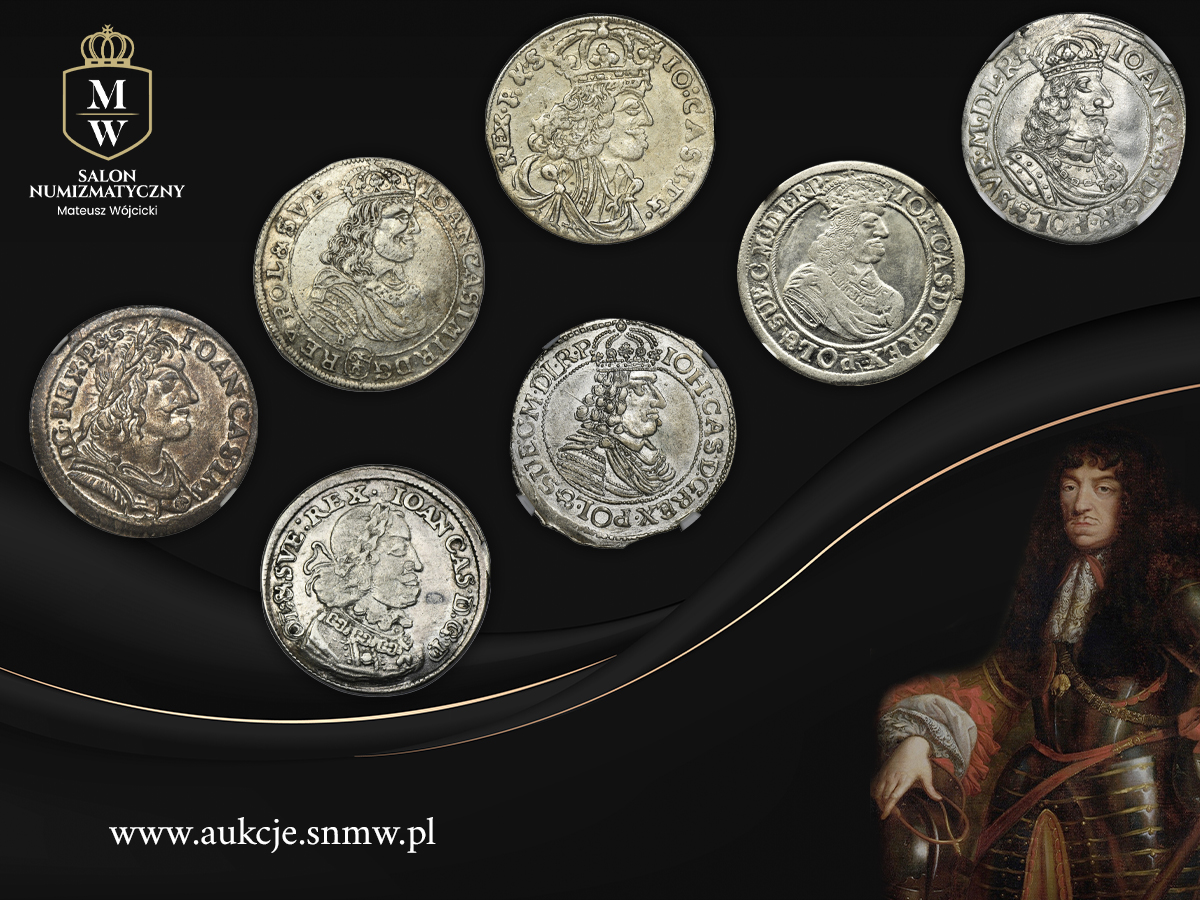
During the times of John Casimir, orts were minted in nine mints: five crown mints (Bydgoszcz, Wschowa, Poznań, Kraków, Lviv), a Lithuanian mint (Vilnius) and three city mints (Gdańsk, Toruń, Elbląg).
The most prolific minting was in Kraków and Bydgoszcz. The mints in Wschowa and Lviv, on the other hand, were distinguished for their iconography. The former, due to the depiction of the king in antique armor and with a laurel wreath on his head (instead of a crown), the latter, due to the primitive nature of the design, which is more reminiscent of folk art than the work of a state mint. Lithuanian ortes were minted only in 1664. Among the city ortes, the Elbląg ortes are the rarest and, consequently, the most coveted by collectors.
The first issues of John Casimir's ort coins were based on the ordinance of 1650. The coins were minted from XIV-grade silver, weighing an average of 5.607 g and containing 4.906 g of pure silver. In 1654, the standard for the ort coins was lowered slightly. The silver fineness was then set at 11 łuty, the weight of a single coin at 6.726 g, and the pure silver content was to be 4.626 g. In 1656, another change occurred: the silver fineness was 11 łuty, the weight was 6.308 g, and the pure silver content was to be 4.337 g. This was not the last change to the ort standard. From 1657, the following values were in force: fineness XII łuty, weight – 5.312 g, pure silver – 3.984 g. The last change was brought about by the ordinance of 1658 (the most lasting of John Casimir's legal acts relating to minting). It established a silver fineness of X łuty for orty, an average coin weight of 6.308 g, and a pure silver content of 3.943 g.

Copyright 2026
Design: Proformat
Copyright 2026
Design: Proformat - Interactive Agency
Wójcicki Polish Auction House
ul. Klemensa Janickiego 2b
50-157 Wrocław
tel.: 696 875 000
tel.: 71 30 70 111
e-mail: [email protected]